The 90-Day Plan: How to Start Adopting AI in Your Company Without the Risk
Instead of a giant project that takes a year and eats the budget, a three-phase plan that turns AI from a slogan into measurable results within three months.
Many chief executives ask me the same question: "We know AI matters — but where do we start?" The usual answer — a company-wide transformation programme, consultants and a three-year plan — often ends in beautiful presentations and very few results.
The alternative that works is the exact opposite: start small, measure precisely, and scale only what works. Here is a practical plan to do that in 90 days.
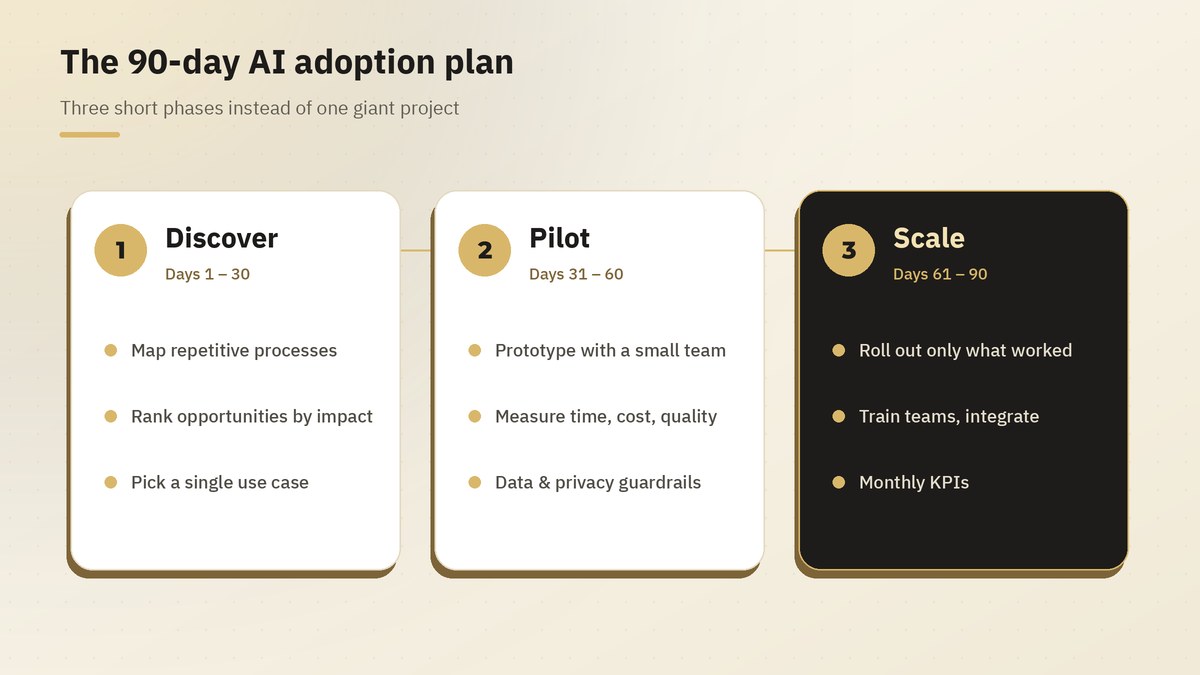
Three short phases, each with clear outputs and a go / no-go decision at the end.
Phase one — Discover (days 1 to 30)
The goal here is not to build anything, but to choose the right problem.
- Map the repetitive processes in every department: which tasks consume hours every week and follow a clear pattern?
- Rank the opportunities on two criteria: impact (time, cost or revenue) and ease of delivery (available data, clear rules, low risk).
- Choose a single use case, ideally an internal one at first, because a mistake there costs less than one a customer sees.
- Appoint an owner from the business, not only from IT. Success depends on the people who live the problem every day.
The output at the end of month one: a single page that defines the problem, today's numbers, and how we will know we have succeeded.
Phase two — Pilot (days 31 to 60)
Now we build — with as little complexity as possible.
- A prototype within two weeks using available tools, without heavy development or full integration with every system.
- A small pilot team of 3 to 10 people who use it in their real work, not in a separate test environment.
- Three metrics: time taken, cost and quality (error rate or user satisfaction) — compared with the baseline.
- Data and privacy guardrails from day one: which data may be used? Where is it processed? Who reviews the outputs?
Phase three — Scale (days 61 to 90)
This is where the most important decision is made: do we roll the pilot out, or stop and pick another opportunity? Stopping here is not failure — it saves money that would otherwise be wasted.
- Roll out only what worked — based on numbers, not impressions.
- Train the teams on correct use and its limits; the biggest barrier to adoption is human, not technical.
- Integrate the solution more deeply with existing systems once its value is proven.
- Set monthly KPIs reported to management, and choose the next use case from the phase-one list.
What makes this plan work?
Sponsorship from the top
When the CEO or the board follows the results every month, teams behave differently. Real adoption is a leadership decision before it is a technical one.
People before tools
The fear of job losses is real and must be addressed openly. Present AI as a tool that frees the team from tedious tasks so they can focus on higher-value work — and genuinely follow through on that.
Patience with the method, not with the results
If there are no measurable results within 90 days, the problem is usually the choice of use case, not the technology. Go back to the list and pick a clearer opportunity.
Conclusion
Adopting AI is not one big project, but a series of small, disciplined experiments. A company that completes three 90-day cycles in a year will have learned — and achieved — more than one that spent the same year planning the perfect transformation programme.