AI Agents: The Next Wave of Business Automation — and How to Prepare
AI is no longer just a tool that answers questions; AI agents complete tasks from start to finish. What that means for your company, and how to start safely and profitably.
Over the past two years, most companies learned to use AI in a single way: you type a question and get an answer. That stage mattered, but it is not the end of the story. The next stage — happening right now — is AI agents: systems that do not stop at answering, but understand a goal, plan the steps, use the company's own tools and systems to complete the whole task, and then review the result.
The difference is like the difference between an employee who answers your questions and one you hand a file to who comes back with the work done. That is exactly why agents are a major opportunity for companies in our region — and a major risk for anyone who adopts them without a method.
What exactly is an AI agent?
An agent is built on a large language model, but it is equipped with three extra things: tools it can use (email, the CRM, databases, the calendar…), memory that keeps the working context, and an execution loop that lets it try, review and retry until it reaches the result.
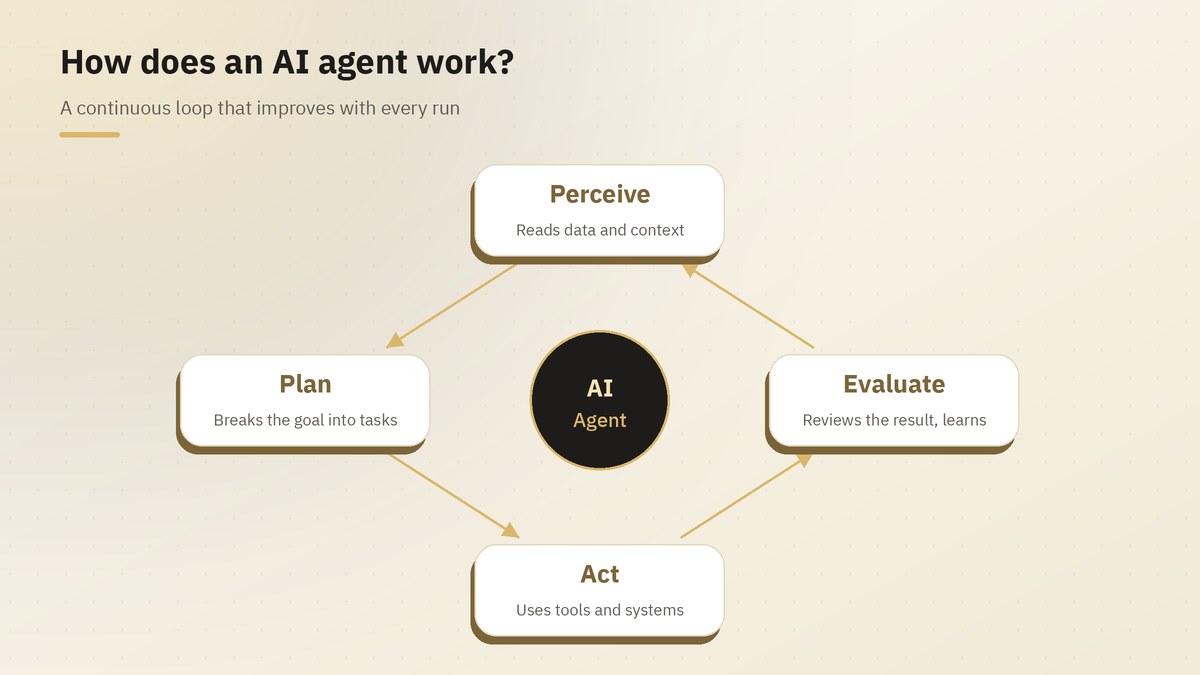
The agent loop: it reads the context, breaks the goal into tasks, acts through tools, then evaluates and improves the result.
How is it different from a chatbot?
- A chatbot answers inside a conversation window — a human does the work.
- An agent does the work inside your systems — a human sets the goal, reviews and approves.
- A chatbot is measured by the quality of its answers; an agent is measured by tasks completed and the time and cost saved.
Where do agents deliver real returns today?
Not every task suits full automation. The best starting points combine three qualities: they are repetitive, their rules are clear, and mistakes are easy to spot and fix. Leading examples include:
- First-line customer service: understanding the request, checking the customer's history, handling simple actions such as rescheduling or order tracking, and routing complex cases to the right person with a ready summary.
- Sales and lead qualification: researching a prospect, assessing fit, drafting a personalised first message and booking the meeting.
- Finance and administration: matching invoices, chasing receivables and preparing recurring reports.
- Healthcare: organising appointments, follow-up reminders and visit summaries that give doctors more time with patients.
- Research and internal content: gathering information from several sources and drafting first versions for the team to review.
Risks to manage from day one
An agent's power is its ability to act — and that is also the source of risk. An agent that can send messages or change data can make a mistake quickly and at scale. Governance is therefore not a later step; it is part of the design:
- Least privilege: give the agent only what it needs for the task, nothing more.
- Human approval for sensitive decisions: payments, external messages and data deletion go through a person first.
- A full log of every action: you must know what the agent did, why and when.
- Data protection: follow your privacy policies and local regulations, and never send sensitive customer data to a service without a clear assessment.
The golden rule: start with an agent that "suggests", then one that "acts with approval", then one that "acts and reports". Do not jump to the third stage before the numbers from the first two earn your trust.
How to start: five practical steps
- Pick one specific, painful process — not "improve customer service" but "answer order-status enquiries".
- Measure today's baseline: how long does the task take, what does it cost, how often does it go wrong? Without a baseline you will not know whether you succeeded.
- Build a first version in weeks, not months, with a small team that uses it daily and gives feedback.
- Set clear limits on what the agent may do, and an escalation path for cases it cannot handle.
- Scale only on the numbers: if time and cost fall while quality holds or improves, move on to the next process.
Conclusion
AI agents will not replace teams, but they will change the shape of work itself: people set goals, make decisions and build relationships, while agents handle repetitive execution. The companies that gain the most will not be the fastest adopters, but the most disciplined: they start small, measure precisely and scale with confidence.
If your company is considering its first AI agent, the most important question is not "which technology?" but "which process deserves to go first?".