AI in Clinics: How It Saves Doctors' Time and Improves the Patient Experience
A large part of a doctor's day goes on administrative tasks that have nothing to do with treatment. That is exactly where AI adds the most value: it takes on the repetitive work so the doctor can return to the patient.
Ask any doctor what drains them most in a day and you will usually hear an answer that has nothing to do with difficult cases: documentation, phone calls, rescheduling, answering the same questions, filling in forms. These tasks are necessary, but they take time away from patients and energy away from the doctor.
AI in clinics is not a robot doctor that diagnoses and treats; it is an assistant that takes on the repetitive administrative work so the medical team can focus on what nobody else can do: listening, examining and making the medical decision.
The AI-assisted patient journey
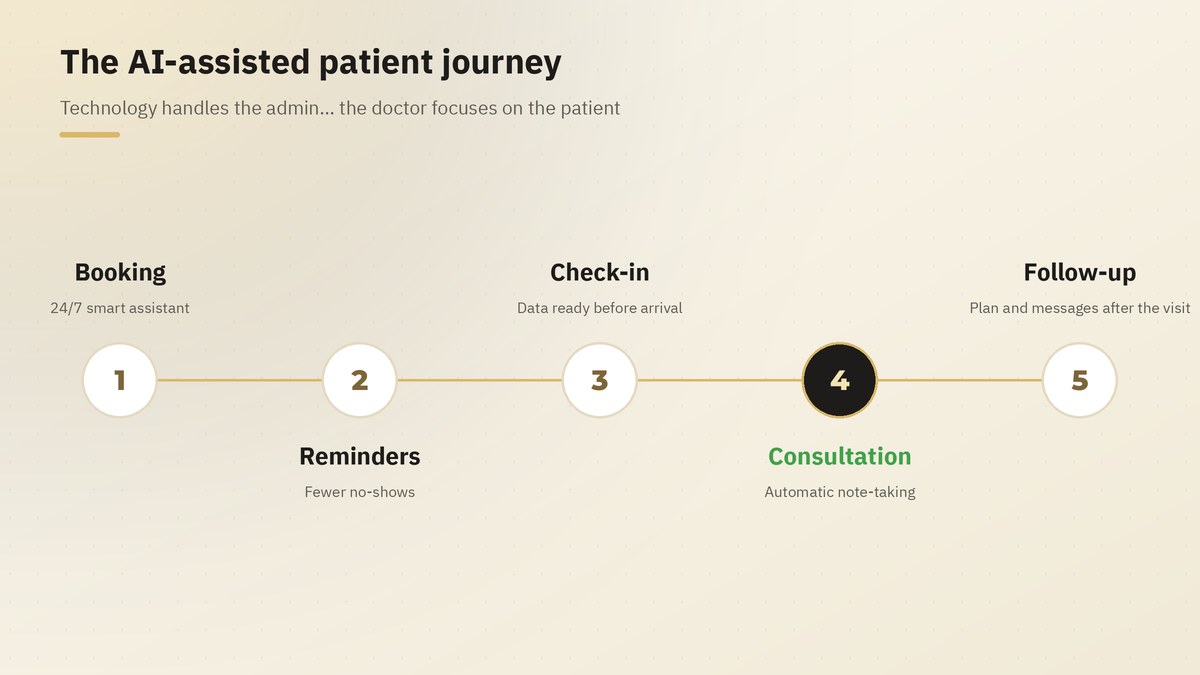
Every stage has an administrative task that can be automated — the medical decision always stays with the doctor.
1. Round-the-clock booking
A smart assistant on WhatsApp or the website answers the common questions — hours, prices, location, accepted insurers — and books the appointment straight into the clinic system, even outside working hours. When it meets a medical question or an urgent case, it hands the patient to the right team or directs them to emergency care.
2. Reminders and fewer no-shows
A missed appointment is a double loss: for the clinic that reserved the time, and for the patient who could have taken the slot. Smart reminders let patients confirm or reschedule in one tap, and offer the freed slot automatically to the waiting list.
3. Faster check-in
A form the patient completes before arriving — symptoms, history, current medication — reaches the doctor summarised and organised. Waiting time drops, and the doctor starts the consultation already knowing the context.
4. Note-taking during the consultation
One of the most impactful applications today: tools that listen — with the patient's consent — to the conversation and prepare a draft of the visit notes in the clinic's usual format. The doctor reviews, edits and approves. The result: more eye contact with the patient, and less screen time after the day ends.
5. Follow-up after the visit
Clear written instructions in language the patient understands, reminders for medication and tests, and a message a few days later to ask how they are doing. These small details make the difference in patient satisfaction and loyalty to the clinic.
Non-negotiable guardrails
- The medical decision belongs to the doctor: any AI output about diagnosis or treatment is a draft that the doctor reviews and approves.
- Patient consent: especially when recording conversations or using their data, the patient must know and agree.
- Protecting health data: health data is among the most sensitive data there is, and must be processed and stored according to the laws and regulations that govern it in each country, with providers that give clear guarantees.
- Transparency: patients should know when they are talking to an automated assistant and when they are talking to a person.
The gold standard for any technology in a clinic: did it increase the time the doctor spends with the patient, or reduce it?
Where should a clinic start?
- Start with the administrative task that takes the most team time — usually answering enquiries and booking.
- Measure today's baseline: number of calls, no-show rate, waiting time and documentation time.
- Pilot the solution for a month with part of your patients, and compare the numbers.
- Expand to the next stage of the patient journey.
Conclusion
The best use of AI in healthcare today is not the most dazzling, but the most modest: taking away from doctors and their teams whatever consumes their time without adding medical value. When that time goes back to the patient, everyone wins.