AI in Marketing: From Writing Content to Smart Personalisation
AI won't replace marketers, but marketers who use it wisely will outperform those who don't. Where it adds real value — and where the decision must stay with people.
The question for marketing teams is no longer "should we use AI?" but "how do we use it without losing our identity and our quality?". The tools are available to everyone, and what makes the difference today is how they are used: do they make your team faster and smarter, or flood your audience with look-alike content without a soul?
Where does AI add value in marketing?
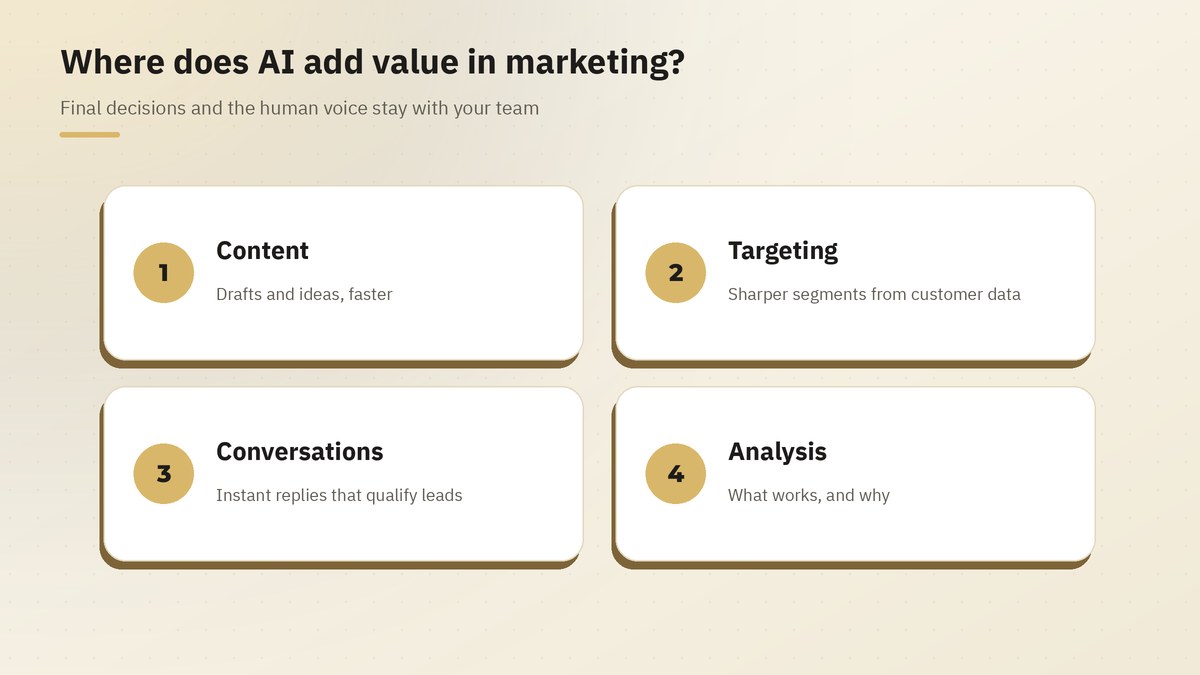
Four areas where AI has a clear impact — as long as decisions and the brand voice stay with your team.
1. Content: drafts and ideas, faster
AI is excellent at generating ideas, writing first drafts, reshaping content for different platforms and suggesting alternative headlines to test. But by nature it writes "the average"; a distinctive point of view, real experience, examples from the local market and your brand's voice are your team's responsibility.
- Use it to get past the blank page, not to produce the final version.
- Give it a clear guide to your brand voice and terminology, with examples of your past content.
- Check every fact and figure — models can state wrong information with confidence.
2. Targeting: sharper segments
Analysing customer data to discover segments with similar behaviour and needs, and predicting which customers are most likely to buy or leave. Many of these capabilities are now built into the ad platforms themselves; your job is to feed them correct conversion data and clear goals.
3. Conversations: instant, qualifying replies
A smart assistant on the website or WhatsApp answers common questions around the clock, gathers the basics of the customer's need, and hands the conversation to the sales team with a ready summary.
4. Analysis: what works, and why?
Summarising campaign performance, extracting patterns from customer comments and reviews, and turning numbers into actionable observations. This is where AI saves hours of manual work in spreadsheets and reports.
Personalisation: the biggest promise
The ultimate goal is for every customer to see the right message at the right time: an email that changes with the reader's interests, offers that match their purchase history, and website content that adapts to their stage in the buying journey. But personalisation must be helpful, not creepy; customers appreciate a relevant recommendation and are put off by feeling watched.
Use AI to make your marketing more human, not less: more relevant messages, faster replies, and more time for your team to think and create.
Guardrails you cannot ignore
- Human review: nothing is published in your brand's name without a responsible person reviewing it.
- Identity and voice: content that sounds like what everyone else publishes weakens your brand, however fast it was produced.
- Privacy: don't put sensitive customer data into tools when you don't know how they process and store it.
- Transparency: when a customer is talking to an automated assistant, they should know.
- Rights and ownership: pay attention to the rights to generated images and materials and their commercial use.
A practical plan to start
- Identify the tasks that consume most of your team's time: drafting, reporting or answering enquiries.
- Try one tool on one task for a month, and measure the time saved and the quality of the result.
- Write an internal usage guide: what is allowed, what isn't, and who reviews.
- Expand gradually to the next tasks once the impact is proven.
Conclusion
AI is changing how marketing teams work at speed, but it doesn't change the fundamentals of marketing: understanding the customer, an honest message and real value. The teams that win will combine the speed of the machine with human judgement — producing more without losing what makes their brand distinctive.