Bootstrapping or Investors? How to Choose the Right Funding Path for Your Startup
Not every startup needs venture capital, and not every round is good news. A practical framework for choosing the funding path that fits your stage and your business.
The media celebrates big funding rounds so much that many founders now treat raising money as a goal in itself. But funding is not an achievement; it is a tool — and it has a price. Every dollar from an investor comes with expectations, a share of your company and a timeline you no longer control on your own.
The right question is not "how do I raise money?" but "do I need it now, why, and what kind?"
A map of the funding stages
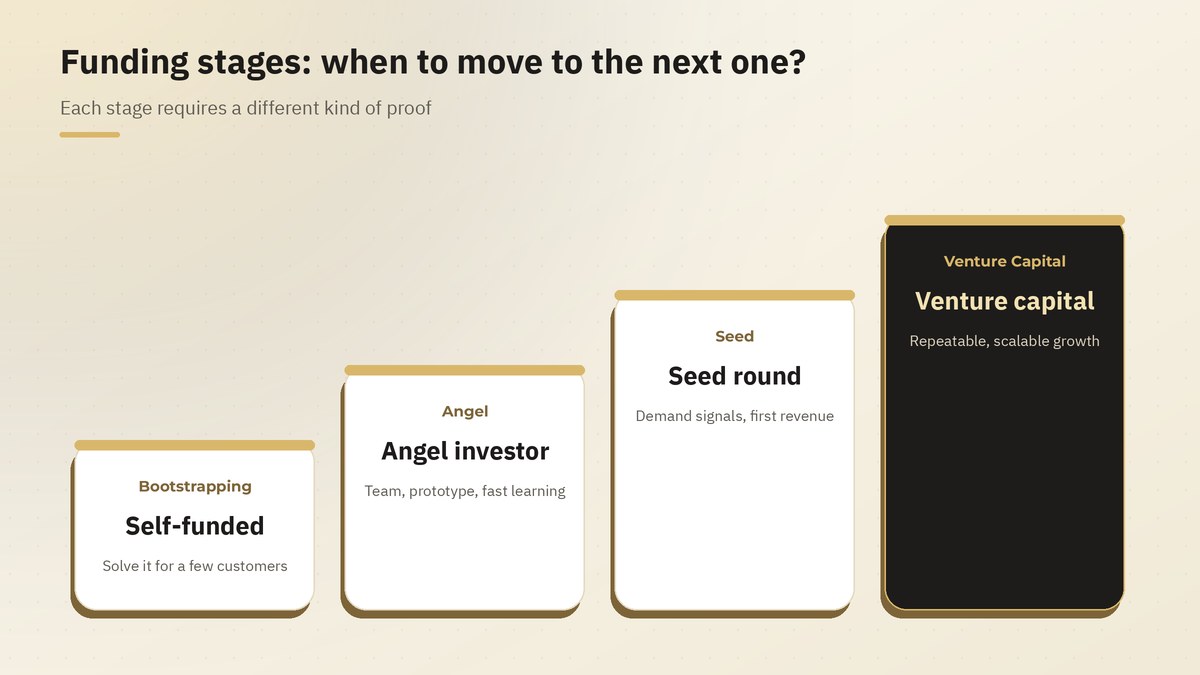
Each stage needs a different kind of proof — moving on before you have it raises the risk and lowers the valuation.
Bootstrapping
The company is funded from your savings or from early customers' revenue. Its great advantage is that you keep full control and are forced to build a profitable model from the start. Its downside is slower growth and higher personal financial pressure.
Right for you when: customers can pay early, the product is cheap to build, and the market is not a race for share.
Angel investors
Individuals who invest their own money at a very early stage, often in the founder before the idea. The best of them bring experience and connections worth more than the money itself.
Right for you when: you have a strong team, a prototype and a clear vision, and need a limited amount to reach your first proof of demand.
Seed round
Usually the first institutional money, aimed at reaching product–market fit. Investors here expect real signals: paying customers, monthly growth and retention.
Venture capital
For companies that have proven a repeatable model and need fuel to scale fast. But remember: VC funds look for outsized returns, so they push you towards maximum growth. That is not right for every company — even successful ones.
Questions that decide your path
- Is the market a race? If the winner takes most of the market, speed matters and funding may be necessary.
- What does it cost to reach your first proof? If it is low, get there yourself and raise later at a higher valuation.
- What exactly will you do with the money? "Growth" is not an answer. "Hire a three-person sales team to enter the Saudi market" is.
- Do you want to build a huge company or a profitable, sustainable one? Both are success — but the roads are different.
The best time to raise money is when you don't desperately need it. Negotiating from strength gets you better terms, a better valuation and better partners.
What are investors really looking for?
- The team: do you have the skills and commitment to deliver the vision?
- Market size: is the opportunity big enough to justify the investment?
- Proof: customers, revenue, growth and retention — in numbers.
- Competitive advantage: why you, why now, and why is it hard to copy you?
- Unit economics: what does a customer cost, and what do they bring over their lifetime?
Final advice before you sign
- Choose an investor the way you would choose a partner — the relationship will last for years.
- Understand every clause in the agreement, and use a specialised lawyer.
- Do not give away a large stake too early; you will need it for future rounds and for your team.
- Keep at least 12 to 18 months of runway after every round.
Conclusion
There is no "correct" funding path for every company. There is the right path for your stage, your market and the kind of company you want to build. Start with the least funding that gets you to the next proof, and make every round the result of progress — not a substitute for it.