Digitising Private Clinics: A Practical Guide from Online Booking to Electronic Medical Records
Many private clinics still rely on an appointment book and paper files. A four-stage roadmap that moves the clinic to digital work without disrupting the team or the patients.
In many private clinics, the day starts with an appointment book, a phone that never stops ringing and an archive of paper files that is hard to search. This model worked for years, but today it costs the clinic more than it seems: missed appointments, lost time, billing errors and an experience that falls short of patients who are used to doing everything from their phone.
Digitising a clinic does not mean changing everything at once. On the contrary, the most successful cases move through clear stages, each delivering a return that funds the next.
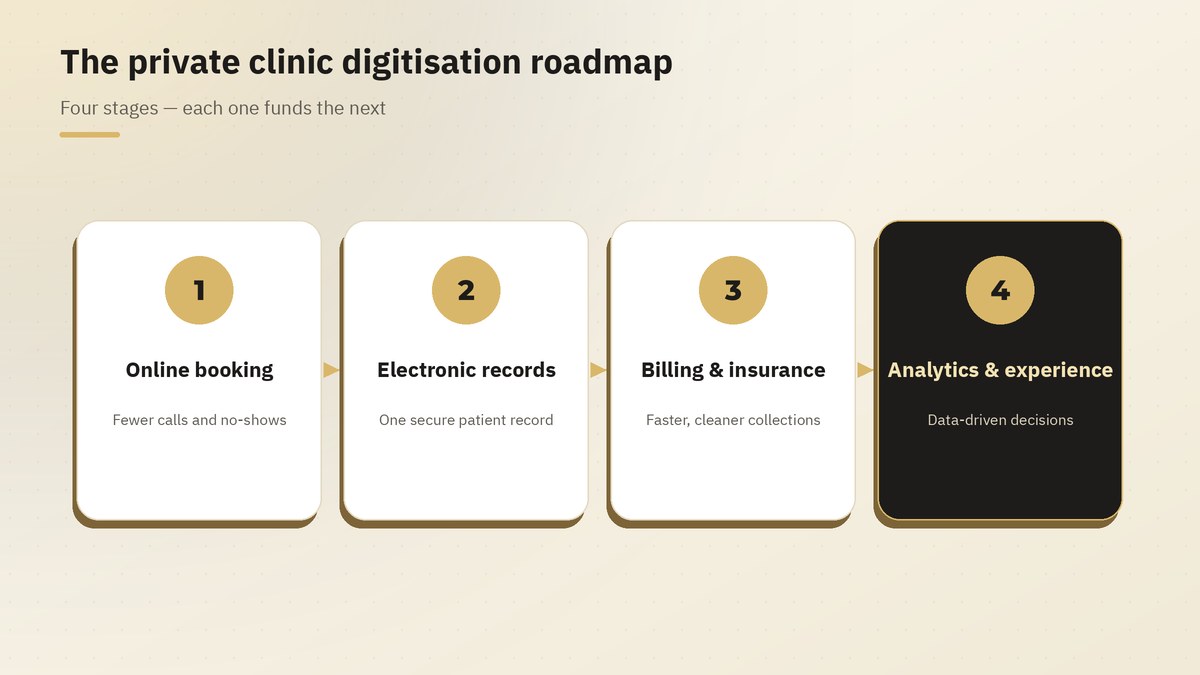
Four consecutive stages — start with what saves time and money immediately, then build on it.
Stage one: online booking
The easiest start with the fastest return. Booking through the website or WhatsApp, automatic confirmation, a reminder before the appointment, and the option to cancel or change without a phone call.
- The return: fewer calls, fewer no-shows and a fuller schedule.
- Tip: make booking possible in as few steps as possible, and show the slots that are really available — not a request form that waits for a reply.
Stage two: electronic medical records
A single record for each patient including visits, diagnoses, prescriptions, tests and images. The doctor can access it in seconds instead of searching the archive.
- The return: better medical decisions with complete information, less time searching and greater patient safety, such as allergy and drug-interaction alerts where the system provides them.
- Tip: don't try to enter the whole old archive at once. Start with active patients and add old files gradually as those patients visit.
Stage three: billing and insurance
Link the consultation directly to the invoice, track insurance claims and their status, and get daily reports on revenue and collections.
- The return: faster collection, fewer claim errors and a clear financial picture for the clinic owner.
- Tip: make sure the system supports your country's e-invoicing and insurers' requirements before you buy.
Stage four: analytics and patient experience
Once digital data builds up, questions appear that could not be answered before: when are the peak hours? Which services are most requested? What share of patients come back for follow-up? What do patients think of their experience?
- The return: data-driven decisions on staffing, opening hours, new services and marketing.
- Tip: a short two- or three-question survey after each visit is enough to improve the experience continuously.
How to choose the right system
- Ease of use before number of features: ask for a real trial with your team before buying.
- Arabic language support in the interface, the reports and patient messages.
- Data protection: where is the data stored? Who can access it? Does the provider comply with local regulations?
- Integration: does it connect to WhatsApp, payment gateways, laboratories and insurers?
- Local technical support and fast response when something goes wrong on a busy day.
- Data ownership: can you export all your patients' data if you decide to change systems?
Don't measure the success of digitising your clinic by the number of new screens, but by one question: has the doctor's day become easier, and the patient's experience better?
The team before the system
The best system in the world will fail if the reception and nursing team are not convinced by it. Involve them in the choice, train them before launch, appoint one person in the clinic as the go-to for questions, and accept that the first weeks will be slower before they get faster.
Conclusion
Digitising a private clinic is neither a luxury nor a huge project; it is a journey of four clear steps. Start with online booking today, and you will find that the time and money it saves open the way to the next steps — until the clinic becomes a place where everyone focuses on what matters most: the patient's health.