Content Marketing: How to Build Trust That Turns into Sales
People don't buy from companies they don't know; they buy from the ones they trust. Content marketing is the most sustainable way to build that trust before the customer needs you.
Think about the last time you chose a doctor, a lawyer, a consultant or even a software company. You probably didn't choose because of an ad, but because of something that made you trust them: a recommendation, an article you read, a video that helped you, or a steady presence that made them familiar.
That is exactly what content marketing does: it delivers real value before asking for anything, building trust that makes the buying decision — when the time comes — an easy one.
Why does content marketing work?
- It reaches customers before they are ready to buy, so you are the first one they remember when the time comes.
- It proves expertise instead of claiming it; an article that solves a problem is more powerful than any slogan saying "we are experts".
- It compounds over time; a good article brings visits for years, unlike an ad that disappears when the campaign ends.
- It feeds every other channel: search, social media, the newsletter and even the sales team.
The hub-and-spoke model
The biggest challenge in content marketing is consistency. The answer is not to produce new content for every platform from scratch, but to build one in-depth pillar piece, then turn it into short pieces suited to each platform.
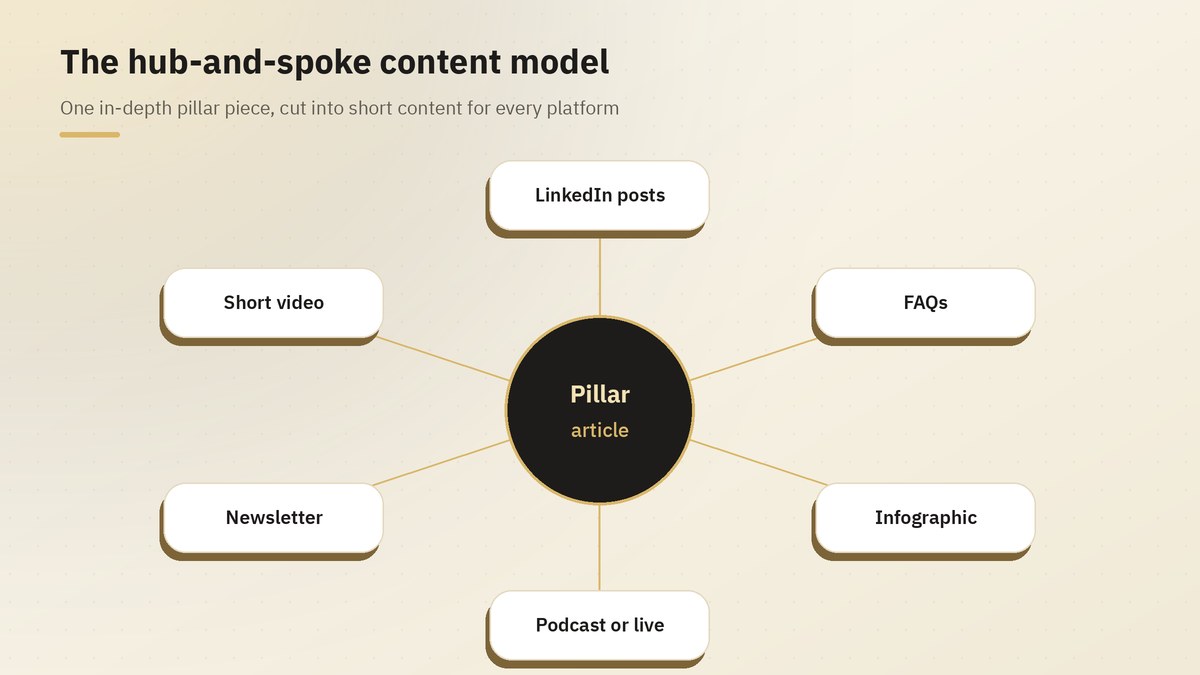
A single pillar article can fuel weeks of content across your platforms.
- Write the pillar article: a comprehensive guide that answers an important question for your audience.
- Extract the key ideas: each one can become a LinkedIn post, a short video or an infographic.
- Turn it into a conversation: a live session or podcast episode that discusses the topic and answers audience questions.
- Send it to your mailing list with a summary and links to more.
- Collect the questions people ask and make them the material for the next pillar article.
The right content for each stage
Awareness: the customer feels the problem
Educational content that helps them understand the problem and its causes: how-to articles, short videos and answers to common questions.
Consideration: the customer is looking for solutions
Content that helps them compare and choose: buying guides, fair comparisons and case studies that show results.
Decision: the customer is ready to buy
Content that removes the last hesitation: customer testimonials, pricing details, FAQs about implementation and support, and a clear next step.
Content that doesn't lead the reader to a clear next step — a sign-up, a download, a booking — builds awareness but doesn't complete the journey.
The personal voice: an advantage for founders and experts
In our region, people tend to trust individuals more than companies. A founder or expert who regularly shares their experience and views — on LinkedIn, for example — builds trust that reflects on the whole company. Share what you learn, the mistakes you avoided and your take on developments in your field — and be consistent rather than perfect.
How to measure the impact
- Reach and engagement: who is reading, watching and engaging — and are they really your target audience?
- List building: how many people subscribed to the newsletter or downloaded a guide?
- Impact on sales: ask every new customer how they found you, and track enquiries coming from content pages.
Conclusion
Content marketing is not a race to produce the most posts; it is a long-term commitment to delivering real value to a defined audience. Start with one pillar article a month, distribute it smartly across platforms, and within a few months customers will come to you already knowing and trusting you before the first conversation.