Digital Transformation Is Not Buying Software: Five Pillars of a Successful Transformation in Arab Companies
Many companies spend large budgets on systems and apps, only to find that nothing has really changed. The reason: technology is just one of the five pillars every real transformation rests on.
"We bought a new ERP, launched an app and moved our files to the cloud… so why don't we feel digitally transformed?" This question comes up in many Arab companies, and the answer is simple and uncomfortable at the same time: digital transformation is not a technology project.
Digital transformation means changing how the company works and how it creates value, using technology. Technology is the means, not the end. When tools are bought before processes and mindsets change, the result is digitised chaos: the same problems, with nicer screens and higher costs.
The five pillars
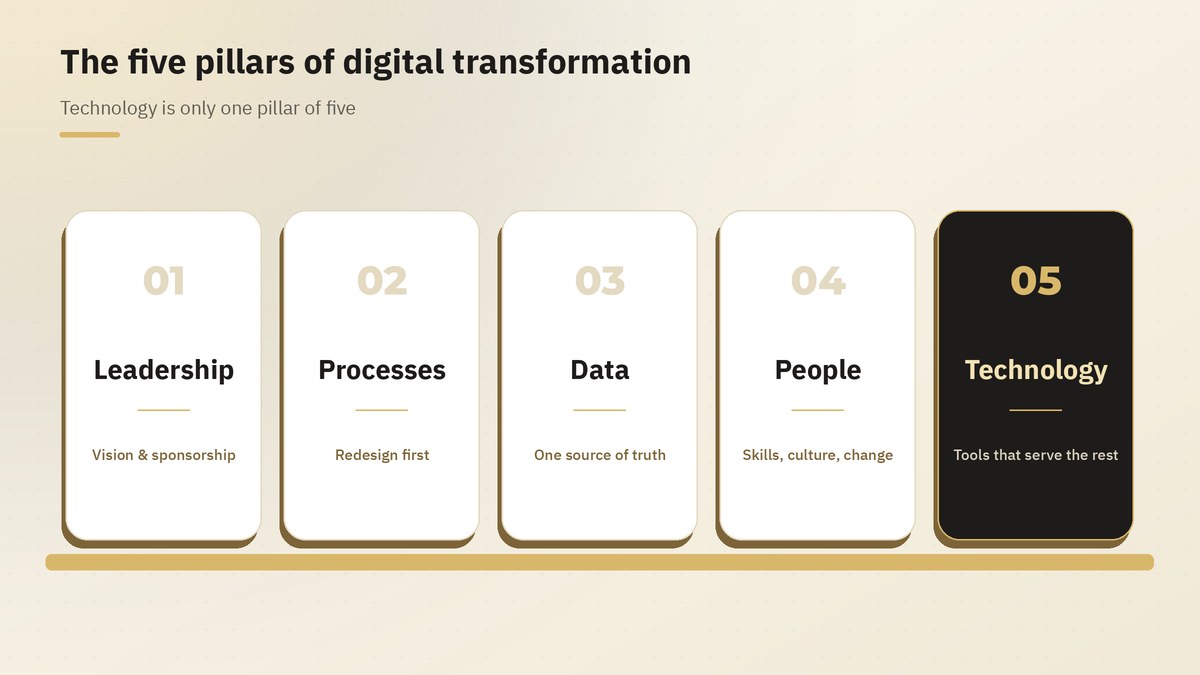
Each pillar carries part of the structure — if one is missing, the whole building leans, however strong the others are.
1. Leadership: vision, sponsorship and decisions
A transformation led by IT alone stays an IT project. A transformation sponsored by the CEO and the board becomes a company-wide priority. Leadership's role is threefold: define why we are transforming (a clear business goal, not "keeping up with the times"), provide the resources, and settle disputes between departments when interests collide.
2. Processes: redesign before you automate
Automating a bad process gives you a bad process that runs faster. Before choosing any system, map today's process as it really is — not as the procedures manual says — and ask: which steps add no value? Which approvals are duplicated? Where does work wait for no reason? Simplifying the process often delivers a large part of the benefit before any technology spend.
3. Data: one source of truth
When sales reports one revenue number and finance reports another, the meeting turns into a debate about which number is right instead of what to do. Transformation requires shared definitions for every metric, clear ownership of every data source, and quality people can trust.
4. People: skills, culture and change
The biggest obstacle to transformation is not technology but resistance to change. An employee who fears losing their job, or does not understand why their way of working changed, will find a thousand ways back to the old way. Investing in training, honest communication and involving teams in designing the solution is not a luxury; it is a condition for success.
5. Technology: tools that serve the rest
Once the goal, processes, data and people are clear, choosing technology becomes much easier and far less risky. The rule: prefer solutions that integrate and scale, start with off-the-shelf before custom development, and do not buy features you don't need today because you might need them tomorrow.
Signs your transformation is heading the wrong way
- The project is measured by the number of systems launched, not by business results.
- Staff work in the new system and in the old Excel sheets "just in case".
- No one in management can name a single metric that has improved since the project began.
- Each department chooses its tools in isolation from the others.
If you cannot explain your company's digital transformation in one sentence that includes a business outcome — such as "cut order fulfilment from five days to one" — you are probably buying technology, not transforming.
How to start
- Choose one journey that matters to customers or the company, such as the order journey from enquiry to payment.
- Map it honestly with the teams who run it every day, and quantify the pain points.
- Redesign it on paper first, then choose the technology that supports the new design.
- Deliver in short phases, and measure the result after each one.
- Move to the next journey once everyone can see the impact of the first.
Conclusion
From the outside, a successful digital transformation looks like a technology story; from the inside it is a story of leadership, processes, data and people. Companies that understand this spend less and achieve more, because they buy technology to solve a clear problem — not to fill a gap in a slide deck.