From Idea to Your First 100 Customers: A Practical Guide for Entrepreneurs in the Arab World
Your first hundred customers do not come from ads or a big launch, but from focused, hands-on work close to the customer. Here is the road, step by step.
Many founders spend months building the product, then launch it and wait. A few visitors come, fewer sign up, and almost nobody pays. The problem is not always the idea — it is the assumption that customers will come on their own.
The truth every founder learns sooner or later: your first hundred customers are won one by one. That is not a weakness; it is the greatest learning opportunity your company will ever get.
Step one: validate the problem before the solution
Before writing a single line of code, talk to potential customers — not to pitch your idea, but to understand their problem:
- How do they deal with the problem today?
- What does it cost them in time or money?
- What have they tried before, and why didn't it work?
- Who makes the buying decision, and who pays?
If the customer is not already looking for a solution — or paying for a bad alternative — the problem may not hurt enough for them to pay you to fix it.
Step two: choose a very small segment
"SMEs in the Middle East" is not a segment; it is a continent. Start with a segment you can reach personally and whose language you understand, such as "private dental clinics in Cairo with more than two dentists". A narrow segment makes your message clearer, referrals faster and your product sharper.
Step three: sell by hand before you automate
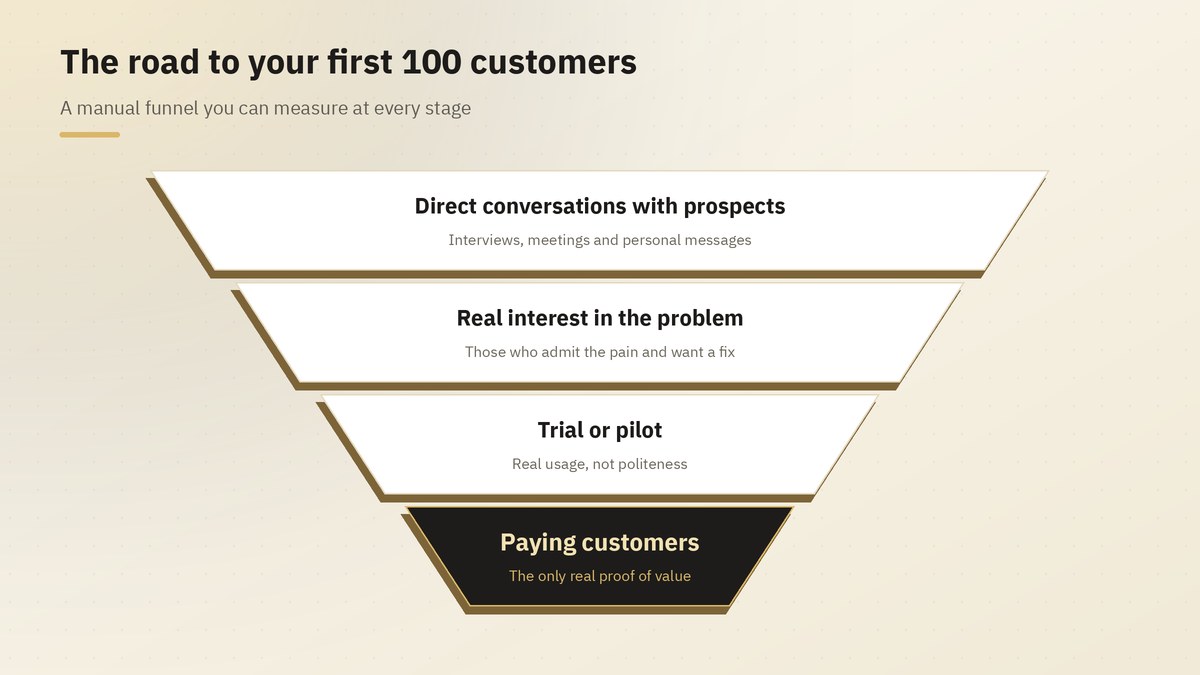
A simple manual funnel: every stage can be counted and improved before you think about ads.
At this stage the founder is the best salesperson. Nobody understands the problem and the vision like you do — and every sales conversation is a free research interview.
- Your personal network first: who do you know that has the problem? Who do they know?
- Direct, personalised outreach: short, personal messages on LinkedIn, WhatsApp or email that talk about the customer's problem, not your product.
- Communities and events: be where your customers gather, and give value before you ask for anything.
- Partnerships: who already serves your customers without competing with you? An accounting software provider, a professional association, an industry adviser.
Step four: ask for money early
The biggest lie in entrepreneurship is "I'll think about pricing later". A customer who says "great idea" has told you nothing; a customer who pays has told you everything. Even if the price is symbolic at first, or a discounted pre-payment, willingness to pay is the real proof of value.
Tips for early pricing
- Price on the value you create for the customer, not on your costs.
- Do not start with a permanent free plan unless your business model is designed for it.
- Respect local payment methods and market expectations; what works in the Gulf may not work in Egypt, and vice versa.
Step five: measure everything, every week
Keep a simple sheet: how many conversations did you have? How many showed real interest? How many tried the product? How many paid — and how many stayed after a month? These five numbers will tell you exactly where the problem is: the message, the product or the price.
Conclusion
Your first hundred customers are not just revenue; they are your partners in building the right product. Know them by name, listen to their feedback, and turn the most successful into case studies and referrals. Then — and only then — scaling with ads and marketing teams becomes a smart investment instead of a gamble.