Generative AI for Startups: How to Build a Competitive Advantage That Cannot Be Copied
When any competitor can use the same language model on the same day, where does your company's value lie? A practical framework for building a real moat on top of generative AI.
Every week, hundreds of new products built on generative AI are launched. Many are impressive in the first demo and gone within months. The reason is simple: if your product is a beautiful interface on top of a language model anyone can use, then any competitor — or even the model provider itself — can offer the same thing tomorrow.
The question every founder should be asking today is not "should we use AI?" but "what is left for us when AI is available to everyone?"
The model is a commodity; value lives in the layers around it
Language models are improving fast and getting cheaper all the time. That is great news for users, but it means the model alone does not create an advantage. The advantage is built in the layers that surround it:
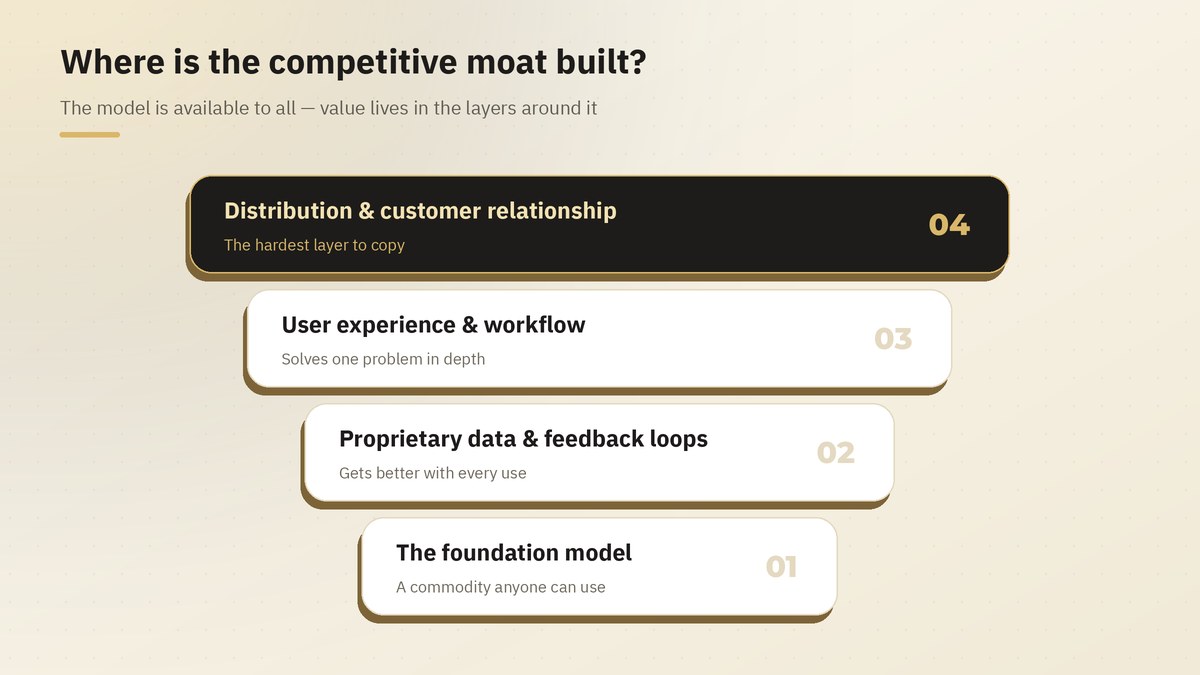
The higher you climb, the harder it is to copy: the model is available to all — your customer relationships are not.
1. Proprietary data and feedback loops
The point is not to have "lots of data", but to have domain-specific data that no one else has, and a loop that makes the product better with every use. Every correction a user makes, every edge case that gets resolved, is knowledge that accumulates with you alone.
2. User experience and workflow
Users do not want "AI" — they want their work done. A product that fits into the daily workflow — inside the tools the team already uses, in the language and terms of the industry — becomes hard to replace. Doctors, lawyers and accountants each have their own way of working; whoever understands it deeply wins.
3. Distribution and the customer relationship
Often the winner is not the company with the best technology, but the one with the best access to customers: partnerships, reputation, understanding of the local market and accumulated trust. In our region in particular, the Arabic language and its dialects, local regulations, payment methods and the way companies make decisions all give local companies a real edge — if they use it well.
Questions every founder must answer
- If the model provider launched a similar feature tomorrow, why would our customers stay with us?
- What data are we collecting today that a new competitor could not easily collect?
- Are we solving one specific problem deeply, or many problems superficially?
- What does each customer cost us in model usage, and does the economics stay profitable at scale?
- Could we switch language models without rebuilding the product?
Do not build your company on a temporary technical lead. Build it on a deep understanding of a specific problem, and on data and relationships that compound over time.
Common mistakes to avoid
- Depending on a single provider with no alternative: design the product so the model can be swapped when prices or policies change.
- Ignoring running costs: many products succeed in the pilot and then lose money on every new customer because model costs were never properly calculated.
- Over-promising: AI sometimes gets things wrong. Design the product so people review sensitive outputs, and be honest with your customers.
- Starting with the technology instead of the problem: "we have a powerful model, let's find a use for it" is the shortest road to a product nobody needs.
Conclusion
Generative AI has lowered the cost of building products like never before, which means competition will be fiercer than ever. The startups that last will treat the model as a component, not as the product, and invest their time in what cannot be bought: understanding customers, proprietary data and trust.