Paid Ads on Meta and Google: How to Measure the Real Return on Every Riyal You Spend
A low cost per click can fool you, and a "successful" campaign may actually be losing money. The measurement chain from impression to profit, and how to make ad decisions based on real returns.
"Our campaign is a huge success: thousands of clicks at a low cost!" Then the month ends, you look at sales, and there is hardly a trace. This scenario repeats because digital ads produce a flood of numbers — and the easiest ones to measure are not necessarily the ones that matter.
The golden rule of paid advertising: don't stop at the click — follow the number all the way to revenue.
The measurement chain: from impression to profit
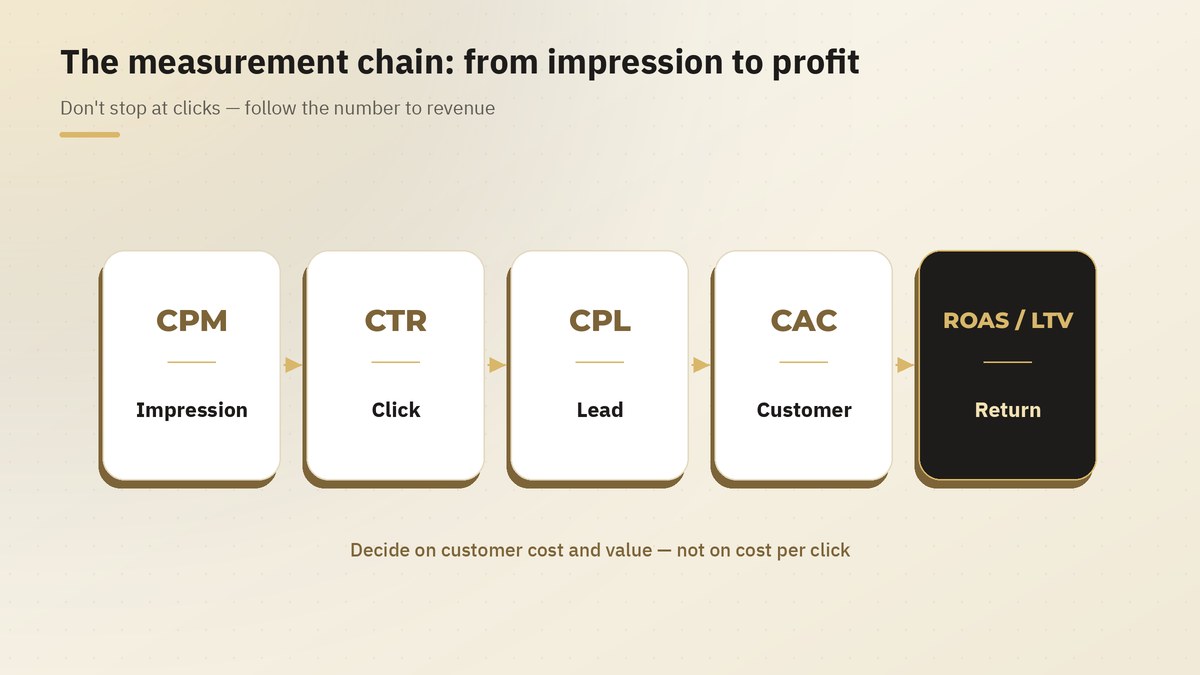
Each link affects the next — and decisions are made at the last link, not the first.
- Cost per thousand impressions (CPM): what do you pay for a thousand people to see your ad? It reflects competition for the audience and the quality of targeting.
- Click-through rate (CTR): how many people out of every hundred who saw the ad clicked? It reflects the strength of the message and creative and how well they fit the audience.
- Cost per lead (CPL): what do you pay for each request, sign-up or conversation?
- Customer acquisition cost (CAC): what do you pay for each customer who actually pays? This is the number that matters.
- Return on ad spend (ROAS) and lifetime value (LTV): what comes back for every unit you spend, and what does a customer bring over their whole relationship with you?
Why the early metrics mislead you
An ad with a high click-through rate may attract the curious rather than buyers. A campaign with a low cost per lead may bring requests that never convert. So always compare campaigns on the cost of a paying customer, not the cost of a click or a sign-up.
The simple rule for any sustainable business: the value of a customer over their relationship with you must exceed the cost of acquiring them by a comfortable margin that covers your other costs and leaves a profit.
Set up tracking before you spend
The biggest mistake is launching campaigns before making sure measurement works. Before spending anything:
- Define the conversion that matters: a purchase, a booking, a quote request or a WhatsApp conversation.
- Install each platform's tracking on the website and confirm conversions are recorded correctly.
- Use distinct links for each campaign so you know where every customer came from.
- Connect ads to actual sales: if you sell by phone or WhatsApp, record each customer's source in your CRM.
Meta or Google?
Google search ads
They reach people already searching for a solution — existing demand. They are ideal for services people look for when they need them: a clinic, a repair, software to solve a specific problem.
Meta ads (Facebook and Instagram)
They create demand among people who may not be searching yet, based on their interests and behaviour. They suit visual products, attractive offers, building awareness of a new brand and retargeting people who visited your site.
Many companies find that combining the two — Google to capture demand, Meta to create it and retarget — gives the best results.
Common mistakes
- Changing everything every day: the algorithms need enough data to learn; give a campaign time before judging it.
- Testing many variables at once: change one element per test so you know what made the difference.
- Neglecting what happens after the click: the landing page and how fast you respond to leads affect the return as much as the ad itself.
- Relying only on the platform's numbers: always compare them with the actual sales in your books.
Conclusion
Paid advertising is a powerful tool for accelerating growth, but it becomes a black hole for the budget when measured with the wrong metrics. Start with correct tracking, base your decisions on the cost and value of the paying customer, and every amount you spend becomes an investment whose return you know.