Five Fatal Mistakes Startups Make in Their First Year — and How to Avoid Them
Most startups do not fail because of a stronger competitor, but because of internal mistakes that could have been avoided. Five mistakes that repeat in year one, and what to do instead.
The first year of any startup is the hardest: limited resources, endless decisions and pressure to prove the idea is worth it. And in this period in particular, the same mistakes repeat across companies, whatever their sector or market.
The good news is that these mistakes are well known and avoidable — if you recognise them early.
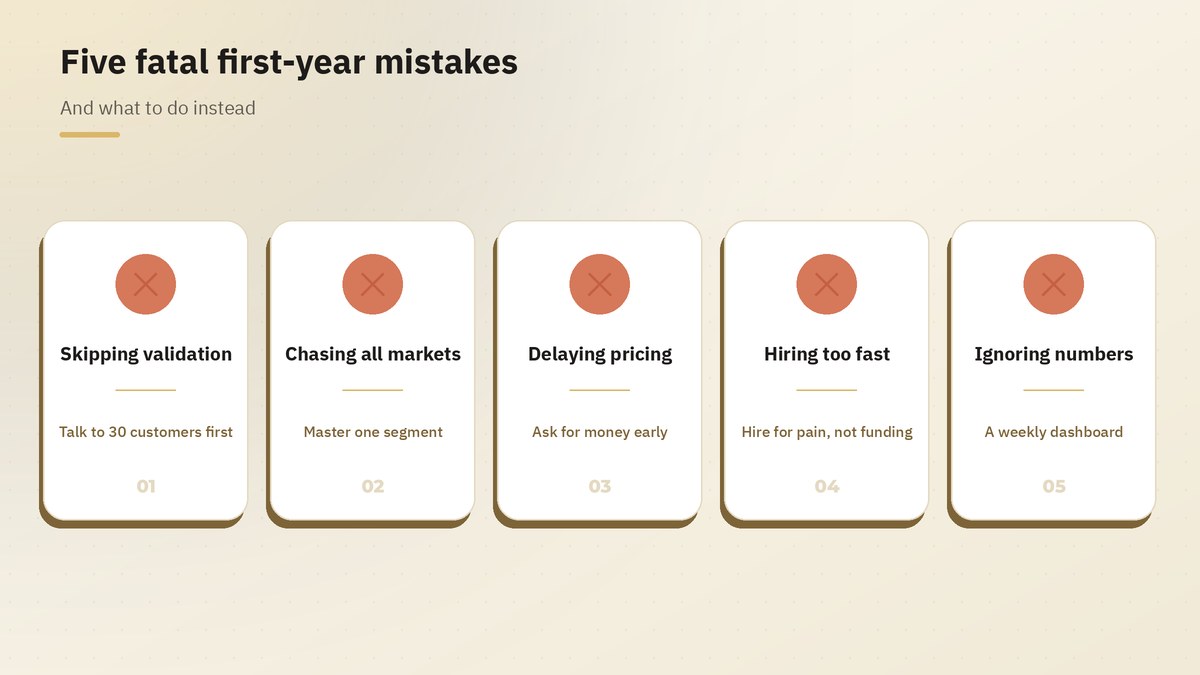
The five most common mistakes — and the practical alternative to each.
1. Building the product before validating the need
The founder falls in love with the solution, spends months building a complete product, and then discovers customers do not need it the way they imagined. The problem is not the quality of execution; it is that the right question was not asked early enough.
Instead: talk to at least thirty potential customers before you build. Build the simplest possible version that tests your most important assumption, even if it is manual behind the scenes. If customers are not excited by a simple version that solves their problem, extra features will not save it.
2. Chasing every market at once
Ambition is good, but a small company trying to serve every sector and every country from day one ends up serving none of them well. The message becomes generic, the product scatters and the team burns out.
Instead: choose one segment and one market and master it. Once you are the first choice for that segment, expanding to the next one is far easier. Expanding between Egypt, the UAE and Saudi Arabia, for example, requires understanding each market on its own terms: its regulations, payment methods and how decisions are made.
3. Delaying pricing and asking for money
Fear of rejection pushes many founders to give the product away "until it proves its value". The result is plenty of users who do not pay, and misleading data about real demand.
Instead: ask for money early. Payment is the real test of value. If customers refuse to pay, that is valuable information telling you to change the product, the segment or the price — and it is far better to learn it in month three than in month eighteen.
4. Hiring fast after raising money
As soon as the money arrives, hiring starts quickly to fill an imagined org chart. Suddenly monthly costs double, communication slows down and flexibility drops — while actual demand for the product has not changed.
Instead: hire when you feel the pain, not when the money lands. Every new role should solve a clear problem the team faces today. And in the early stage, look for versatile people who are comfortable with ambiguity, because roles will change a lot.
5. Making decisions on impressions instead of numbers
"I feel things are getting better" is not a KPI. Many companies discover too late that churn is high, or that customer acquisition cost exceeds customer value, because nobody was tracking the numbers regularly.
Instead: a simple weekly dashboard you review with your team every week. You do not need complex tools — a single sheet is enough at first, including:
- New customers and new revenue.
- The share of customers still active after one and three months.
- Customer acquisition cost compared with what each customer brings in.
- Monthly burn and remaining runway.
What gets measured gets managed. A startup that knows its numbers precisely makes faster and bolder decisions than its competitors.
A bonus mistake: neglecting the founder's wellbeing
Entrepreneurship is a marathon, not a sprint. Chronic exhaustion leads to bad decisions, tension in the team and sometimes to leaving the company altogether. Sleep, exercise and time with family are not luxuries; they are part of the company's sustainability.
Conclusion
Succeeding in year one does not require avoiding every mistake — that is impossible — but avoiding the fatal ones, and spotting and fixing the others quickly. Validate before you build, focus before you expand, ask for money early, hire carefully and measure everything. These five principles alone put your company ahead of most of its competitors.