Marketing and Sales on WhatsApp in the Middle East: From Conversation to Loyal Customer
In our region, many buying decisions start and end inside a WhatsApp chat. How to turn this channel from random messages into an organised sales system that respects customers and delivers results.
Ask any shop, clinic or service company owner in Egypt or the Gulf which channel most of their customers use to reach them, and the expected answer is: WhatsApp. Customers in our region prefer to ask, negotiate and book through a personal conversation rather than filling in forms or waiting for email replies.
Yet many companies treat WhatsApp as an extra phone rather than a sales channel: messages delayed for hours, repeated questions without ready answers, and prospects lost in a pile of chats. The real opportunity is to turn WhatsApp into an organised sales system.
The sale inside the chat
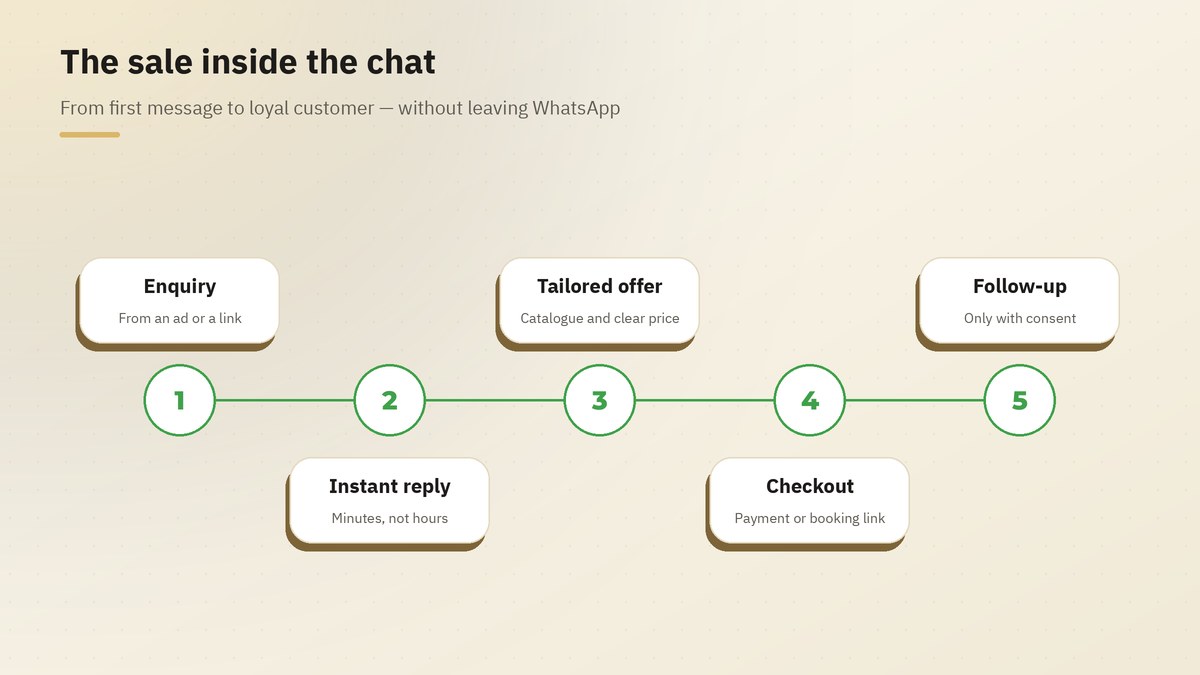
Every stage can be improved and measured — and the customer never needs to leave the conversation.
1. The enquiry
Make starting a conversation easy from everywhere: a WhatsApp button on the website, a link in your ads and social profiles, and a QR code in your shop or clinic. Meta ads can also lead straight into a WhatsApp chat instead of a landing page.
2. The instant reply
Response speed on WhatsApp is half the sale. A customer who waits too long has often messaged your competitor in the meantime. Use automatic greetings, saved replies for common questions and clearly stated business hours.
3. The tailored offer
Use the catalogue to present products and services with images and prices, and offer what fits the need you understood from the conversation — not a generic list of everything.
4. Checkout
Every extra step loses you customers. Send a payment or booking link directly in the chat, and confirm the order with a clear message containing the details and the next step.
5. Follow-up
A message after delivery or the visit to make sure the customer is satisfied, a reminder for the next appointment or re-order, and relevant offers later — only with the customer's consent.
WhatsApp Business: the app or the platform?
- The WhatsApp Business app: right for small businesses — a business profile, catalogue, quick replies, greeting and away messages, and chat labels.
- The WhatsApp Business Platform (API): right when conversation volume grows and more than one person needs to reply, or when WhatsApp must connect to a CRM, a booking system or a smart assistant.
Smart automation without losing the human touch
An automated assistant is excellent at answering repeated questions, collecting initial information and confirming appointments. But customers must be able to reach a person easily whenever they need to. The best experiences let the assistant handle the start and the routine tasks, then hand the conversation to a team member with a full summary, so the customer never has to explain again.
WhatsApp is a personal space for the customer. A message they didn't ask for, or one that keeps nagging, doesn't just cost you one sale — it can cost you the customer for good.
Rules to respect
- Don't send marketing messages to anyone who hasn't explicitly agreed to receive them.
- Make opting out easy and clear.
- Follow WhatsApp Business policies — breaking them can get your number restricted.
- Protect customer data and conversations, and decide who on your team may access them.
What to measure
- Average time to first response.
- The share of conversations that turn into an order or booking.
- The source of each conversation: which ad or page did the customer come from?
- The share of customers who buy again.
Conclusion
In the Middle East, WhatsApp is not just a messaging app; it is a shop, a front desk and a customer service centre at once. Companies that organise this channel — with fast replies, clear offers, smart automation and respect for customer privacy — turn everyday conversations into sales and long-term relationships.